
In today’s crowded marketplace, brands are constantly seeking innovative ways to stand out and connect with their target audience. One strategy that has gained significant traction is partnership marketing. But what exactly is partnership marketing, and why is it becoming increasingly important for businesses of all sizes?

Why Brands Love Partnership Marketing
Partnership marketing is a strategic alliance between two or more brands that allows each to reach the other’s audience. It’s a collaborative effort where brands combine their strengths, resources, and audiences to create mutually beneficial marketing campaigns or initiatives. This partnership marketing definition encompasses a wide range of activities, from co-branded products to joint advertising efforts and shared content creation.
Let’s break down the key elements of partnership marketing:
- Collaborative Effort: Partnership marketing is fundamentally about cooperation. It involves two or more brands working together towards shared goals, rather than competing against each other.
- Combining Strengths: Each partner brings its unique strengths to the table. This could be brand reputation, technical expertise, strength in a particular marketing channel, creative capabilities, or specific product features. The partnership leverages these complementary strengths to create something greater than what either brand could achieve alone.
- Shared Resources: Partners often pool their resources, which can include promotional investments, organic marketing channels, customer data, technology platforms, or brand influencers/ambassadors. This resource-sharing can lead to more impactful campaigns and initiatives.
- Audience Exchange: One of the primary benefits of partnership marketing is the ability to tap into each other’s audience base. This cross-pollination of audiences can help brands expand their reach and attract new customers.
- Mutually Beneficial Campaigns: The goal is to create marketing initiatives that benefit all parties involved, including the partnering brands and their customers. This could, for example, be through co-branded products, joint promotions, shared content creation, or collaborative events.
- Value Creation: Successful partnerships focus on creating additional value for their customers. This could be in the form of enhanced products or services, unique experiences, exclusive perks/discounts, or added convenience.
- Shared Risks and Rewards: Partners typically share both the risks and rewards of their joint initiatives. This can include sharing costs, dividing benefits, or jointly managing potential reputational impacts.

At its core, a partnership marketing strategy involves:
- Identifying complementary brands or businesses
- Developing a mutually beneficial plan
- Executing joint marketing campaigns or initiatives
- Sharing resources, audiences, and success metrics
The Evolution of Partnership Marketing
 Partnership marketing isn’t a new concept, but it has evolved significantly in the digital age. Historically, partnerships might have involved simple co-branding exercises or shared advertising space. Today, partnership marketing companies facilitate complex, multi-channel collaborations that leverage the full power of each brand’s organic assets, digital marketing tools and platforms.
Benefits of Partnership Marketing

“No matter how brilliant your mind or strategy, if you’re playing a solo game, you’ll always lose out to a team.” — Reid Hoffman, Co-founder of LinkedIn
This quote captures the essence of why partnership marketing works. It highlights the power of collaboration in achieving business objectives that might be challenging or impossible to accomplish alone. Let’s explore the key benefits that partnership marketing offers to businesses:
- Breaking Through the Noise: Traditional advertising methods are losing their effectiveness in an increasingly fragmented media environment. Partnership marketing offers a unique opportunity to break through the noise and create meaningful connections with target audiences. By combining the strengths and audiences of multiple brands, partnerships can create more compelling and attention-grabbing initiatives than either brand could achieve alone.
- Expanding Reach Through Mutually Beneficial Collaborations: By partnering with another brand, you gain access to their customer base, effectively expanding your visibility and reach without additional marketing spend. This allows you to tap into new markets or demographics that might have been difficult to access on your own, helping you increase your visibility in today’s crowded marketplace.
- Building Trust with Customers: Associating your brand with a respected partner can boost your credibility and trustworthiness in the eyes of consumers. This is particularly beneficial when entering new markets, appealing to different customer segments, or rejuvenating an established brand image.
- Cost-Effective Marketing Solutions and Improved Marketing ROI: Partnerships allow you to leverage shared resources, potentially reducing costs while increasing the impact of your marketing efforts. Rather than simply buying media, brands can leverage the organic media they already own and, in exchange, gain access to their partner’s organic media. This can lead to a better return on investment (ROI) for your marketing spend and more cost-effective campaigns overall.
- Innovation Catalyst: Collaboration often sparks innovation. When two brands with different perspectives and expertise come together, it can lead to new ideas, activations, products or services that neither would have developed independently. This drives innovation and keeps your offerings fresh and competitive.
- Gaining a Competitive Advantage: Strong partnerships can create unique value propositions that set you apart from competitors. This differentiation can be a key factor in attracting and retaining customers in a crowded marketplace, making your brand stand out.
- Risk Mitigation: By sharing resources and efforts, partnerships can help distribute the risks associated with new marketing initiatives or entering new markets. This allows for more ambitious projects with potentially higher rewards.
- Accelerating Growth: Partnerships can accelerate business growth by providing quick access to new capabilities, technologies, or market segments without the need for extensive internal development or large media investments. This can be particularly valuable in fast-moving industries or when trying to capitalize on emerging trends.
- Enhancing Customer Experience: By combining the strengths of multiple brands, partnerships often result in improved products, services, or experiences for customers. This leads to increased customer satisfaction, loyalty, and potentially higher customer lifetime value.
- Creating Learning Opportunities: Working closely with another brand provides valuable learning opportunities, allowing you to gain insights into different business practices, technologies, or market segments. This knowledge sharing can drive long-term business improvements beyond the specific partnership initiative.
- Developing Engaging Campaigns: Partnerships often lead to more creative and engaging marketing campaigns. The combined creativity and resources of two brands can result in standout initiatives that capture consumer attention more effectively than solo efforts.
 By leveraging these benefits, partnership marketing allows brands to create unique value propositions, reach new audiences, and achieve marketing objectives more efficiently than they could on their own. In today’s interconnected business landscape, partnership marketing has emerged as a crucial tool for brands seeking to expand their influence, innovate their offerings, and create meaningful connections with their target audiences.
Types of Partnership Marketing: Choosing the Right Approach
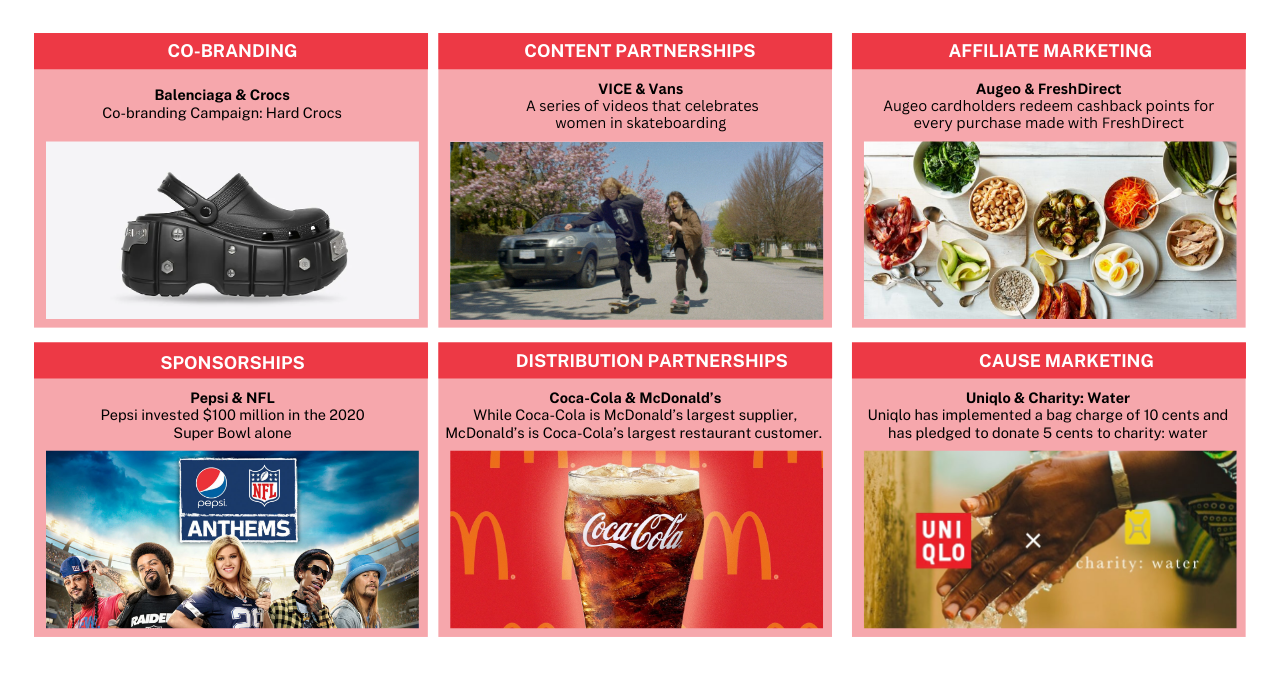 Understanding the various types of partnership marketing can help you choose the right approach for your brand. Here are some common types:
- Co-Branding: Two or more brands collaborate to create a new product or service.
- Content Partnerships: Brands work together to create and distribute valuable content.
- Affiliate Marketing: One brand promotes another’s products for a commission.
- Sponsorships: A brand supports an event, team, or individual associated with another brand.
- Distribution Partnerships: Brands collaborate to expand their product or service availability.
- Cause Marketing: For-profit businesses align with non-profit organizations for mutual benefit.
How to Create a Successful Partnership: Key Strategies
 Creating a successful partnership requires careful planning and execution. Here are some key strategies:
- Define Clear Objectives: Establish what you hope to achieve through the partnership.
- Choose the Right Partner: Look for brands with complementary values and audiences.
- Develop a Mutually Beneficial Plan: Ensure both parties stand to gain from the collaboration.
- Set Clear Expectations: Define roles, responsibilities, and success metrics.
- Communicate Effectively: Maintain open and regular communication throughout the partnership.
- Measure and Optimize: Continuously evaluate the partnership’s performance and make adjustments as needed.
Examples of Successful Partnership Marketing Campaigns
 Let’s look at some real-world examples of successful partnership marketing campaigns:
1. Crocs’ Brand Transformation

Crocs provides an excellent example of the power of partnership marketing. The brand transformed its image from an “ugly” shoe to a fashion statement by collaborating with high-profile brands and celebrities. As Michelle Poole, Crocs President, explains: “We look at the other brand partner and we think about what they bring to the table. And we say, ‘What’s the angle? What’s the story here? What does the consumer get?”
2. GoPro and Red Bull: “Stratos”

GoPro and Red Bull partnered for the “Stratos” project, where Felix Baumgartner jumped from the edge of space. This partnership showcased the perfect alignment between Red Bull’s extreme sports image and GoPro’s adventure-capturing technology. The event was live-streamed to millions, creating massive exposure for both brands and cementing their association with pushing the boundaries of human achievement.
3. Spotify and Uber: “Soundtrack for Your Ride”

Spotify and Uber joined forces to enhance the ride-sharing experience by allowing passengers to become the DJ of their Uber ride. This partnership integrated Spotify’s music streaming service directly into the Uber app, allowing users to personalize their journey with their own playlists. This collaboration added value to both services, improving customer experience for Uber while increasing engagement and exposure for Spotify.
These examples demonstrate how partnership marketing can transform brand perception, create unique experiences, and add value for customers in ways that neither brand could achieve alone. By carefully selecting partners and focusing on creating meaningful experiences for consumers, these brands have successfully leveraged partnership marketing to drive growth and enhance their market positions.
Overcoming Challenges in Partnership Marketing
While partnership marketing offers numerous benefits, it’s not without its challenges. Some common pitfalls include:
- Misaligned objectives
- Unclear value propositions
- Poor communication between partners
- Inadequate resource allocation
- Failure to measure and optimize performance
To overcome these challenges, it’s crucial to:
- Clearly define goals and expectations from the outset
- Ensure strong alignment in brand values and target audiences
- Establish clear communication channels and protocols
- Allocate sufficient resources to support the partnership
- Implement robust tracking and analytics to measure success
The Role of Partnership Marketing Companies

Partnership marketing companies play a crucial role in facilitating successful collaborations. These specialized agencies bring expertise in:
- Identifying potential partners
- Negotiating mutually beneficial agreements
- Developing integrated marketing strategies
- Managing partnership execution
- Measuring and optimizing partnership performance
By leveraging the expertise of a partnership marketing company, brands can maximize the benefits of their collaborations while minimizing potential risks and challenges.
The Future of Partnership Marketing

As we look to the future, partnership marketing is likely to become even more important in the marketing mix. Emerging trends include:
- AI-driven partner matching
- Virtual and augmented reality collaborations
- Blockchain-powered partnership agreements
- Hyper-personalized partnership experiences
- Increased focus on purpose-driven partnerships
By staying ahead of these trends, brands can position themselves to leverage the full potential of partnership marketing in the years to come.
Harnessing the Power of Partnership Marketing
In conclusion, partnership marketing is a powerful strategy that allows brands to combine their strengths, reach new audiences, and create innovative marketing campaigns. By understanding the benefits, types, and best practices of partnership marketing, brands can unlock new opportunities for growth and customer engagement.
The collaborative nature of partnership marketing allows businesses to achieve more than they could alone. By combining strengths, sharing resources, and working towards common goals, partnering brands can create powerful synergies that drive mutual success and deliver enhanced value to customers.
In today’s interconnected business landscape, partnership marketing has emerged as a crucial tool for brands seeking to expand their influence, innovate their offerings, and create meaningful connections with their target audiences. Whether you’re a small startup or a global corporation, incorporating partnership marketing into your strategy can help you stay competitive and thrive in an ever-evolving marketplace.
Want to learn more about partnerships? Download our white paper on Unlocking the Power of Marketing Partnerships!
Related Posts

How Scentbird x RuPaul’s Drag Race Turns Product Placement Into Participation
The Scentbird x RuPaul’s Drag Race partnership reimagines product integration by turning fragrance into a participatory fan experience. Through in-show activations and season-long visibility, the collaboration demonstrates how modern brand partnerships can move beyond traditional placement and create deeper cultural engagement.

Partnership Trilogy: Outlander x Drift x Scentbird
The Outlander x Drift x Scentbird collaboration demonstrates how experiential partnership marketing can extend storytelling beyond the screen. By integrating scent into the viewing ritual, the partnership transforms a season premiere into a sensory experience, offering a blueprint for how entertainment brands can move from exposure to immersion.

It’s YOUR Happy Place: HERSHEY’S Olympic Activation Strategy
Hershey’s Olympic activation goes beyond logo placement. By transforming medal symbolism into a limited-edition retail product, the brand turns global visibility into measurable sell-through. Here’s how cultural alignment, retail strategy, and digital participation create a modern partnership blueprint.
